
Binary Adaptive Quantum-Inspired Optimizer : A Novel Wrapper Feature Selection Approach with Lévy-Guided Collapse and Opposition-Based Initialization
Keywords:
Feature selection ;Binary metaheuristic;Quantum-inspired optimization;Opposition-based learning ; Lévy flight ; Wrapper method;UCI benchmarks; ClassificationAbstract
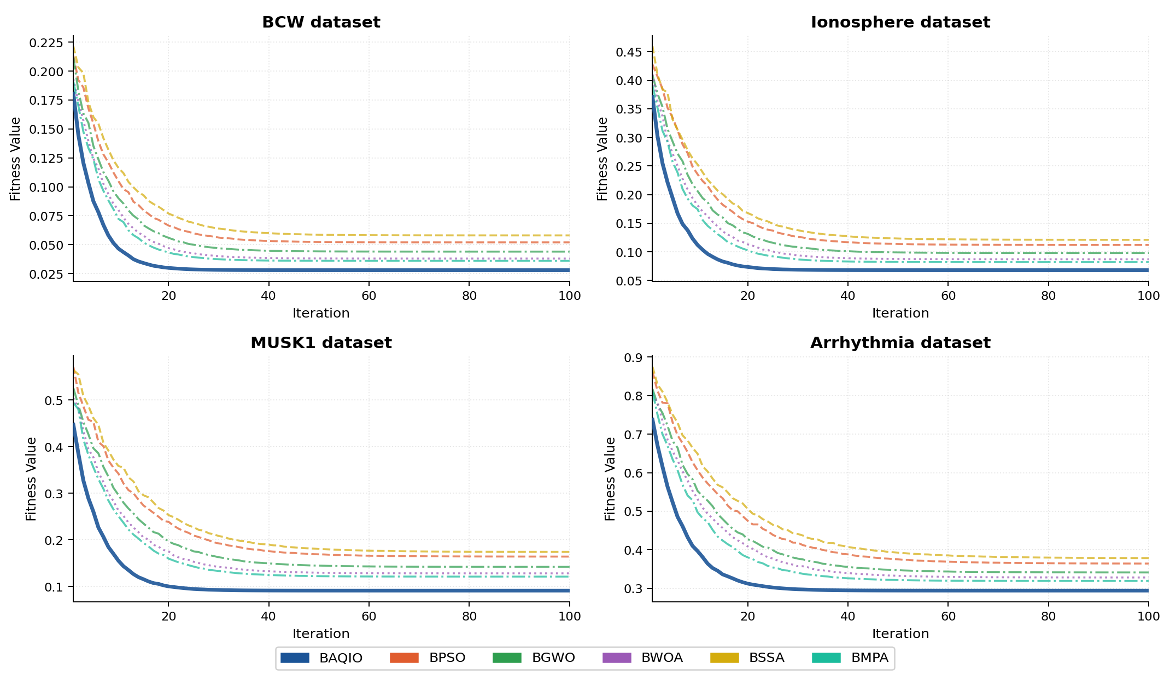
Feature selection is a critical preprocessing step in knowledge-based systems and machine learning pipelines, directly affecting model accuracy, interpretability, and computational efficiency. This paper proposes BAQIO, a Binary Adaptive Quantum-Inspired Optimizer, a novel wrapper-based feature selection algorithm that addresses three limitations prevalent in existing binary metaheuristics: loss of population diversity caused by rapid convergence, inadequate exploration of high-dimensional discrete search spaces, and sensitivity to initialization quality. BAQIO encodes each feature subset as a quantum-bit string, where each bit is represented by a rotation angle that probabilistically collapses to a binary observation. Three cooperative mechanisms drive the search: (i) an adaptive rotation angle update that modulates the quantum collapse intensity based on the fitness difference between each individual and the global best; (ii) Lévy-guided stochastic jumps applied to rotation angles of the elite sub-population to enable wide-range exploration; and (iii) opposition-based initialization, which initializes both the original and complementary quantum states and retains the better half, doubling the effective coverage of the binary feature space. BAQIO is evaluated on 18 standard UCI datasets spanning binary and multi-class problems, low- and high-dimensional feature spaces (9 to 12,533 features), and varying sample sizes (32 to 5,000 instances). It is benchmarked against eight state-of-the-art binary optimizers — BPSO, BGWO, BWOA, BSSA, BMPA, BHHO, BSCA, and BARO — using KNN (k = 5) as the classifier. BAQIO achieves the highest classification accuracy on 16 of 18 datasets and the smallest selected feature subset on all 18. Wilcoxon signed-rank tests with Bonferroni correction confirm that BAQIO's improvements are statistically significant against all eight competitors on at least 14 of 18 datasets (α = 0.05).
Downloads
References
[1] I. Guyon, A. Elisseeff, An introduction to variable and feature selection, J. Mach. Learn. Res. 3 (2003) 1157–1182.
[2] Y. Zhang, S. Wang, P. Phillips, G. Ji, Binary PSO with mutation operator for feature selection using decision tree applied to spam detection, Knowl.-Based Syst. 64 (2014) 22–31.
[3] A. Selvakumar, K. Muneeswaran, Firefly algorithm based feature selection for network intrusion detection, Comput. Secur. 81 (2019) 148–155.
[4] M. Mafarja, S. Mirjalili, Whale optimization approaches for wrapper feature selection, Appl. Soft Comput. 62 (2018) 441–453.
[5] M. Dash, H. Liu, Feature selection for classification, Intell. Data Anal. 1 (1997) 131–156.
[6] H. Liu, L. Yu, Toward integrating feature selection algorithms for classification and clustering, IEEE Trans. Knowl. Data Eng. 17 (2005) 491–502.
[7] S. Mirjalili, A.H. Gandomi, Chaotic gravitational constants for the gravitational search algorithm, Appl. Soft Comput. 53 (2017) 407–419.
[8] E. Hancer, B. Xue, M. Zhang, Differential evolution for filter feature selection based on information theory and feature ranking, Knowl.-Based Syst. 140 (2018) 103–119.
[9] R. Eberhart, J. Kennedy, A new optimizer using particle swarm theory, in: Proc. MHSPC, 1995, pp. 39–43.
[10] S. Emary, H.M. Zawbaa, A.E. Hassanien, Binary grey wolf optimization approaches for feature selection, Neurocomputing 172 (2016) 371–381.
[11] M. Mafarja, S. Mirjalili, Whale optimization approaches for wrapper feature selection, Appl. Soft Comput. 62 (2018) 441–453.
[12] M.A. Elaziz, D. Yousri, S. Mirjalili, A hybrid Harris hawks-moth flame optimization algorithm including fractional-order chaos maps and evolutionary population dynamics, Adv. Eng. Softw. 154 (2021) 102973.
[13] A.A. Heidari, S. Mirjalili, H. Faris, I. Aljarah, M. Mafarja, H. Chen, Harris hawks optimization: Algorithm and applications, Future Gener. Comput. Syst. 97 (2019) 849–872.
[14] M. Mafarja, S. Mirjalili, Efficient hybrid nature-inspired binary optimizers for feature selection, Cogn. Comput. 12 (2020) 150–175.
[15] B. Crawford, R. Soto, M. Astorga, J. García, C. Castro, F. Paredes, Putting continuous metaheuristics to work in binary search spaces, Complexity 2017 (2017) 1–19.
[16] S. Rahnamayan, H.R. Tizhoosh, M.M.A. Salama, Opposition-based differential evolution, IEEE Trans. Evol. Comput. 12 (2008) 64–79.
[17] K.-H. Han, J.-H. Kim, Quantum-inspired evolutionary algorithm for a class of combinatorial optimization, IEEE Trans. Evol. Comput. 6 (2002) 580–593.
[18] Y. Zhang, S. Wang, G. Ji, A comprehensive survey on particle swarm optimization algorithm and its applications, Math. Probl. Eng. 2015 (2015) 1–38.
[19] X. Li, J. Zhang, M. Yin, Animal migration optimization: An optimization algorithm inspired by animal migration behavior, Neural Comput. Appl. 24 (2014) 1867–1877.
[20] P. Larrañaga, J.A. Lozano (Eds.), Estimation of Distribution Algorithms: A New Tool for Evolutionary Computation, Kluwer Academic Publishers, Boston, 2002.
[21] C.R. Raquel, P.C. Naval, An effective use of crowding distance in multiobjective particle swarm optimization, in: Proc. GECCO 2005, ACM, 2005, pp. 257–264.
[22] R. Kohavi, G.H. John, Wrappers for feature subset selection, Artif. Intell. 97 (1997) 273–324.
[23] E.-G. Talbi, Metaheuristics: From Design to Implementation, Wiley, Hoboken, NJ, 2009.
[24] S. Mirjalili, SCA: A sine cosine algorithm for solving optimization problems, Knowl.-Based Syst. 96 (2016) 120–133.
[25] L. Abualigah, M. Abd Elaziz, P. Sumari, Z.W. Geem, A.H. Gandomi, Reptile Search Algorithm (RSA): A nature-inspired meta-heuristic optimizer, Expert Syst. Appl. 191 (2022) 116158.
[26] Z. Beheshti, BMPA-V-shaped: A binary marine predators algorithm using V-shaped transfer function for feature selection, J. Ambient Intell. Humaniz. Comput. 14 (2023) 1–21.
[27] H. Wang, Z. Wu, S. Rahnamayan, Y. Liu, M. Ventresca, Enhancing PSO using generalized opposition-based learning, Inf. Sci. 181 (2011) 4699–4714.
[28] R.N. Mantegna, Fast, accurate algorithm for numerical simulation of Lévy stable stochastic processes, Phys. Rev. E 49 (1994) 4677–4683.
[29] D. Dua, C. Graff, UCI Machine Learning Repository, University of California, Irvine, CA, 2019. http://archive.ics.uci.edu/ml.
[30] M. Mafarja, I. Aljarah, A.A. Heidari, A.I. Hammouri, H. Faris, A.-Z. Ala'M, S. Mirjalili, Evolutionary population dynamics and grasshopper optimization approaches for feature selection problems, Knowl.-Based Syst. 145 (2018) 25–45.
[31] A.E. Hassanien, I. Yamany, H.M. Zawbaa, Binary dragonfly algorithm for feature selection, in: Proc. AECIA 2017, Springer, 2017, pp. 309–318.
[32] Q. Al-Tashi, S.J. Abdulkadir, H.M. Rais, S. Mirjalili, H. Alhussian, Approaches to multi-objective feature selection: A systematic literature review, IEEE Access 8 (2020) 125076–125096.
[33] N.H. Awad, M.Z. Ali, J.J. Liang, B.Y. Qu, P.N. Suganthan, Problem Definitions and Evaluation Criteria for the CEC 2017 Special Session on Numerical Optimization, Technical Report, Nanyang Technological University, 2016.
[34] A. Tharwat, T. Gaber, Classification based on genetic programming approach: A comprehensive survey, IEEE Access 9 (2021) 146064–146075.
[35] Z. Dong, S. Wang, N. Ahmad, I. Ullah, S. Waseem, Y. Zheng, Enhanced binary dragonfly algorithm for feature selection in high-dimensional data, Expert Syst. Appl. 227 (2023) 120294.
[36] I. Aljarah, A.M. Al-Zoubi, H. Faris, M.A. Hassonah, S. Mirjalili, H. Saadeh, Simultaneous feature selection and support vector machine optimization using the grasshopper optimization algorithm, Cogn. Comput. 10 (2018) 478–495.
[37] J. Too, A.R. Abdullah, N. Mohd Saad, W. Tee, EMG feature selection and classification using a Pbest-guide binary particle swarm optimization, Computation 7 (2019) 12.
[38] S. Mirjalili, S.M. Mirjalili, A. Lewis, Grey wolf optimizer, Adv. Eng. Softw. 69 (2014) 46–61.
[39] S. Mirjalili, A. Lewis, The whale optimization algorithm, Adv. Eng. Softw. 95 (2016) 51–67.
[40] S. Mirjalili, A.H. Gandomi, S.Z. Mirjalili, S. Saremi, H. Faris, S.M. Mirjalili, Salp swarm algorithm: A bio-inspired optimizer for engineering design problems, Adv. Eng. Softw. 114 (2017) 163–191.
Published
Issue
Section
License
Copyright (c) 2026 othmane houdaif, elarbi lamfarrad (Author)

This work is licensed under a Creative Commons Attribution 4.0 International License.